Sunday, February 6, 2011

Book Drum for the Bibliophiles


Whether you are a book lover who is enthralled when they find a hidden allusion in their books, or one of those types who use books as sleeping aids, Book Drum is highly recommended.

What is Book Drum?

Instead of sifting through hundreds of reviews and plot summaries to look for the perfect book, you can come to Book Drum to look through over 100 great profiles. Each book profile consists of a Summary, a Glossary, a Review, a biography of the Author, a note on the Setting, and a collection of “Bookmarks” that refer to specific passages in the text.

Each profile is built by people like you and me (although I haven’t started on mine yet). As long as you have the spare time, enthusiasm, reasonable writing skills and an Internet connection, you can build a Profile on a book you know well.

There are profiles for every genre, from classics to horror to poetry, even non-fiction. If you are ever found yourself unable to finish a paper because you don’t understand the text, Book Drum is the perfect place to get you through the process.

The 2011 Book Drum Tournament

To enter the 2011 Tournament, choose a published book and create a Profile of it, consisting of a Summary, a Review, a Glossary, an illustrated Setting page, a biography of the Author, and a comprehensive set of illustrated Bookmarks. Book Drum's interactive system makes it easy to do, and the chance to research a book in detail is richly rewarding.

Take some time to look though the six sections of a sample profile first. For a guide to building a profile, see the Contributor Guidelines.

A list of Recommended Books is provided, but you can choose a different book if you prefer. It should be published by a mainstream publisher, and must be widely available. Please check your choice with us in case there’s some reason why it might not be suitable: editor@bookdrum.com.

Only one person may profile any given book. Where a profile already exists, or is under construction, the book may not be chosen. Check your choice here: Profiles under construction or already published. Please note that to ensure popular titles are not reserved and left untouched, we may reclaim titles if no significant progress has been made within three weeks.

Profiles of your own books are not eligible in the Tournament. Authors may however create and publish profiles of their own titles as normal while the Tournament is running.

The Tournament is open to anyone over 18 other than the winners of the 2010 Tournament first and second prizes. The five runners-up in the 2010 Tournament are free to enter.

The prizes will be awarded by three independent judges. Results will be announced on 31 May 2011.

Deadline for Entries: 30 April 2011

Friday, January 28, 2011

Book Review: 'The Death of Vishnu' by Manil Suri


A drunkard named Vishnu is dying on the first floor landing of an apartment building in Mumbai, India; the tenants of the building go on with their lives. The Death of Vishnu is Manil Suri’s first novel. Suri uses Vishnu, the second god of the Hindu triad and as the preserver of the universe, to symbolize the ideology of reincarnation. The book does not neatly tie off the various story lines in the end. As with reincarnation, the end only represents a link in the infinite chain of creation. Just because the book ends, doesn’t mean the characters’ lives end too.

On the first floor of the apartment, the housewives, Mrs. Asrani and Mrs. Pathak, argue over who will pay for an ambulance. On the second floor, Mr. Jalal decides to search for higher meaning after his wife accuses him of not having faith. On the top floor, Vinod Taneja’s longs for the wife he has lost. Kavita, Mrs. Asrani’s daughter, runs off with Salim, the son of Mr. Jalal.

The Death of Vishnu lacks a defined plot, but instead provides snapshots of each characters present. With each snapshot is a glimpse of their past in the form of memories that give the stories and characters feeling, depth, and meaning. As the reader you are shown the paths the characters have walked and then are allowed to briefly walk beside them.

Readers usually have a prejudice towards the end. You will hope that Mrs. Asrani and Mrs. Pathak will put aside their pettiness as Vishnu lies dying; that Mr. Jalal will finally find what he is looking for; that Vinod Taneja will find another woman; that Kavita will live happily ever after with Salim; and that Vishnu dies.

However, all that does not happen, with the exception of Vishnu. Vishnu dies.

Manil Suri does a beautiful job of presenting his readers with the memories and feelings of each character. Its portrayal makes one believe he/she is one with the characters.

Monday, January 24, 2011

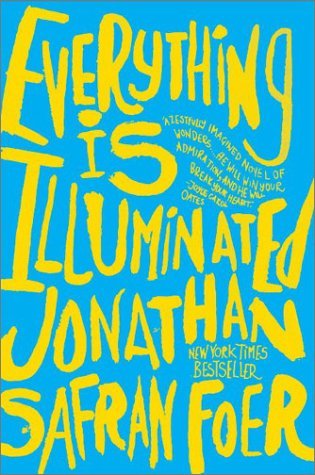
Book Review: "Everything is Illuminated" by Jonathan Safran Foer


Jonathan Safran Foer, 24 years old at the time of publication, has claimed his stake for literary greatness with his first novel Everything is Illuminated.

Illuminated is a different kind of novel. The ingenuity of Safran Foer’s wordplay and the structure of the story is the main attraction of the book.

The novel disguises itself as a story about the quixotic journey of a young man, who shares a name with the author, in search of a woman who allegedly saved his grandfather from the Nazis. Accompanied by Alex Perchov, a Ukrainian native, Alex’s “blind” grandfather, and their “seeing-eye bitch,” Sammy Davis, Jr. Jr. the characters explore themes such as love, history, memory, narrative, and death.

As their journey progresses, so does the development of its characters. The novel starts off with Alex giving a narration about himself, which gives way to his quirkiness, such as his ownership of a thesaurus but no dictionary.

“My legal name is Alexander Perchov. But all of my many friends dub me Alex, because that is a more flaccid-to-utter version of my legal name. Mother dubs me Alexi-stop-spleeningme!,

because I am always spleening her. If you want to know why I am always spleening her, it is because I am always elsewhere with friends, and disseminating so much currency, and performing so many things that can spleen a mother.”

Safran Foer’s play with Alex’s broken English gets to be obnoxious as you finish the chapter. But you can’t help but wonder how Safran Foer came up with this linguistic ingenuity. With every turn of the page, Alex’s English becomes less inhibited and gains dignity.

The novel contains two stories, both elaborately intertwined. Alex retells the story of his and Foer’s journey to Trachimbrod, a fictional Ukrainian shtetl (town). While in between chapters, excerpts of Jonathan’s novel-in-progress recount the history of Trachimbrod from its birth in 1791 to its death in the 1940s. These chapters are filled with famous monuments and excerpts from books written by inhabitants of Trachimbrod from its time to certify the existence of the shtetl.

The novel was adapted into a film starring Elijah Wood in 2005; however, it does not do justice to the book. The film presents itself in a manner lost in translation. The alterations of the plots change the meaning of the book altogether, abandoning most of the major themes.

With the wittiness of its verbal exchange and the humorous antics, Illuminated seems like a big joke. However, “everything is illuminated” by the time you reach the last word.

Friday, August 20, 2010

Reading the Bible as Literature


My friend prompted me to read Proverbs from the Bible. Before he even finished the sentence, I can feel my heart starting to beat faster, my blood pressure rising, and my mind in chaos generating excuses to avoid the subject. I am not kidding.

It is not that I am anti-Christianity, but I’ve never enjoyed the teachings. But mostly, I never enjoyed anything that sounded preachy. I stopped going to Bikram Yoga because it became more of a Bikram Choudhury worship than a yoga practice. I just couldn’t concentrate when the instructor quoted Bikram every time I lay down for Savasana. When being preached to, I start to feel my soul being sucked right out of me.

I decided to give the Bible another try, and as a bibliophile, recommendations are never passed up. I told myself to read the selection solely as a piece of literary art. Proverbs proved to be a bit of a challenge to pick out its aesthetics.

I started out reading the King James Version, but ended up reading the Contemporary English version. The more I read the King James Version, the angrier I became. The inability to comprehend all of what I was reading partly contributed to the frustration. After switching to the Contemporary English Version, I was less resentful. However, I was still unable to appreciate the Bible as I do with the typical fiction and nonfiction I am used to reading. I still had the nagging feeling that I had to follow all these commandments in order to gain God’s favor.

I did find one verse that I liked.

We make our own plans, but the Lord decides where we go.
                                                                                        Proverbs 16:9

That verse basically sums up what I believe in, the idea of Christian existentialism. We are responsible for giving meaning to our lives; we must take “a leap of faith.” At the same time, we must trust that our decisions will be evaluated in the face of God, for holding oneself up to Divine scrutiny was the only way to judge one's actions. Because I know I am unable to fulfill all of God’s commandments, I get a looming notion of despair. I never liked adhering to rules. I often use them as guidelines.

It is so hard for me to get away from the mindset of the religious aspect of the Bible. While I am unable to appreciate the Bible as literary, I will try to read it as existential literature.

Tuesday, September 29, 2009

Paradox of My Character: A review of Dick Meyer's Why We Hate Us


People who know me personally know that I yearn to move out of the United States. Why, they would ask? I tell them that I despise America for its futile arguments over controversial issues, its sudden attentiveness for the environment, and its exploitative use of media.

One day, I was picking up at book on the hold shelf in the library. As I rushed across the library to check it out (I forgot to feed the parking meter), a title stopped me in my tracks. It was called “Why We Hate Us: American Discontent in the New Millennium by Dick Meyer. I was surprised. I couldn’t believe there was a book about this. I found out later, every word Meyer wrote were my exact same thoughts, except with better wording.

Meyer explains that our discontent is fueled by bullshit, belligerence, and boorishness, which are brought on by phoniness and the revolution of technology. The more I read, the more my thoughts unraveled and the more cynical I became (as if I wasn’t cynical enough already). At the same time, I felt myself unraveling. I came to realize that Meyer was talking about me. I was shocked. I always thought I was part of the solution, but Meyer says differently. I am why we hate us.

Truthiness

I talk a lot of bullshit, but not a lot of people are able to spot it. I call it truthiness, a term coined by Stephen Colbert. Now in the Webster’s dictionary, truthiness is defined in two ways: 1) truth that comes from the gut, not books, and 2) the quality of preferring concepts of facts one wishes to be true, rather than concepts of facts known to be true. When truthinesses clash, it’s a pointless argument ready to happen.

I make you believe that natural and fair trade products are good for you and for the people on the other side of the world, despite the fact that natural doesn’t always mean the ingredients were obtained fairly or that fair trade is really that fair.

I disable you as a fan of a certain music artist just because I don’t like their music. I don’t have a legitimate reason to not like them, but I embellish my reason to make it sound reasonable just so I have something to say.

I just demonstrated Meyer’s theory that belligerence flows from bullshit. Meyer writes, “The idea of choosing goods and values individually, by taste and preference, is what truthiness is all about. It actually has a philosophic pedigree. It is called ‘emotivism,’ a term resurrected by MacIntyre from early nineteenth-century British philosophy. In After virtue, MacIntyre defines it this way: “emotivism is the doctrine that all evaluative judgments and, more specifically, all moral judgments are nothing but expressions of preference, expressions of attitude or feeling.” So in this view there is no difference between saying ‘the death penalty is wrong’ and ‘I don’t like the death penalty.’ ‘Gay marriage is immoral’ is just another way of saying ‘I don’t like gay marriage.’ Now you see why we are getting nowhere with issues of gay rights and abortion.

Belligerence

“The need to make others wrong has turned into an addiction,” writes Meyers. That is very true…for me. As a former debater, I am unable to let go of my debating habit. To win a round, all I have to do is prove to the judge that the other party wrong.

Another habit obtained from debating, is producing arguments that are not necessarily the view of one’s own beliefs. I have also brought this habit into my world outside of debate. I can, on the spot, make up a plausible explanation for (almost) anything to provoke an argument; because I am convinced I can prove you wrong 90% of the time.

We are faced with belligerence all the time, especially on TV. Do you know what is common in all those reality shows? Drama. Contestants are always fighting with each other. Meyer compares reality TV to voyeurism, “part of the allure of reality TV is the voyeuristic thrill of watching real people fight and melt down—and the performers deliver. Game shows goad contestants into catfights. We enjoy watching the naked aggression of exhibitionists. We find it entertaining, even soothing.” Remember the Jerry Springer Show and all the fights hunky Steve had to break up?

Balkinization

This is, in some way and not, where I offend America the most. Meyer defines cultural Balkinization as “exaggerated attachments to a point of view or single issue.” People place identifiers on themselves every day. I’ll point myself out. I call myself a tennis player, a swimmer, and a gymnast. In reality, I can’t serve, it takes me 32 seconds to swim 50 meters, and I can’t do the splits.

Identifiers are very common these days. Meyer takes it to the next level to say that “people have an increased need to display badges of their own personal ‘Balkin states’ to the world with the whole branding concept in fashion and marketing” which I am guilty of.

Balkinization leads to a type of phoniness, called artificiality. I never noticed my artificiality until I walked into a certain Wal-mart. Every time I walk into that certain Wal-mart, I get jeers and stares. It’s a little uncomforting. Then I realize it might be what I am wearing and carrying into the store—a Coach purse and shoes, Armani Exchange t-shirt.

Why We Hate Us brought my life into perspective. Usually with these kinds of epiphany, I find myself trying to minimize these traits. However, I feel I am unable to make myself more authentic or stop from starting an argument when opportunity arises. Meyer offers a remedy to make us belittle our hatefulness. To sum it up in one sentence, he says “strive to make thoughtful choices using a sound moral temperament.” I guess acknowledging my hatefulness is a start.

Friday, August 14, 2009

Revisiting Human Nature: Review of Jonathan Swift’s Gulliver’s Travels


It took me three attempts and a month to recount Gulliver’s lifetime travels.

I started reading this when I was 13 years old. I never got past the Lilliputians.

I finally decided to give Gulliver’s Travels another try. I thought to myself “maybe I was just too young to appreciate Swift.”

Through my perseverance, I found that Swift’s work is brilliant. It is simple yet complex at the same time. As many of you know, Gulliver’s Travels is famously known for its satire of the human nature. Each of the inhabitants of Gulliver’s destination has contrasting characteristics/traits of the preceding destination. Gulliver is big/small/sensible/ignorant, the countries are complex/simple/scientific/natural, and forms of Government are worse/better/worse/better than England's. Gulliver's view between parts contrasts with its other coinciding part — Gulliver sees the tiny Lilliputians as being vicious and unscrupulous, and then the king of Brobdingnag sees Europe in exactly the same light. Gulliver sees the Laputians as unreasonable, and Gulliver's Houyhnhnm master sees humanity as equally so.

I was about to stop reading because the plot became repetitive. Gulliver would set out on a voyage and meet with some misfortune that causes him to land in these strange territories. He takes residence for a large amount of time in each locale while learning the population’s traditions and language. By some absurd manner, Gulliver always finds a way back to England.

The first two parts were not too interesting. However, one’s perspective on things become extremely distorted depending on your relative size to the environment. In Gulliver’s case, being a minute organism compared to the dwellers in Brobdingnang brought him to realize the repulsiveness of the physical human feature. He was small enough to see the unevenness of the Brobdingnangians skin caused by the pores. He was also small enough to see the excrement flies leave behind. If I experienced what Gulliver has seen, I would immediately become embarrassed. I can imagine the Lilliputians feeling just as disgusted. Also, be very conscious of where flies are landing.

I am glad I continued reading. The found the third part very meaningful and thought-provoking, and hilarious. The unreasonableness of the inhabitants of Lagado makes it very amusing. Gulliver visits an academy established to develop new theories on agriculture and construction and to initiate projects to improve the lives of the city’s inhabitants. However, the theories have never produced any results and the new techniques have left the country in ruins. Gulliver meets a scientist trying to turn excrement back into food, an architect trying to build a house from the roof down, and an agronomist designing a method of plowing fields with hogs by first burying food in the ground and then letting the hogs loose to dig it out.

In Luggnagg, Gulliver was introduced to struldbrugs, immortal ones who are forever old rather than forever young. When asked what he thought life would be like if he was a struldbrug, Gulliver answers by saying he would try to obtain all riches and knowledge. However, the king of Luggnagg advises Gulliver that being immortal is a curse rather than a godsend.

Before reading Gulliver’s response, I knew that would be his response. That would be the typical response of the majority of people. I remember having a similar discussion as we were reading Natalie Babbitt’s Tuck Everlasting in middle school. Would I want to live forever? I would have said yes back then, but now I would not want to live forever. Death is like a deadline. You would not live your life to the fullest or accomplish anything if you knew you had all the time in the world. This begs for another question and a topic for another time: why wealth and knowledge?

The last part was also very serious. In the country of the Houyhnhnms, horses are the master race and human-like creatures, called Yahoos, are the subordinates. The horses were skeptical about Gulliver as he looked exactly like the Yahoos, except with clothes on. However, he is eventually taken in by the horse household after exhibiting some notion of reason. As time goes by, Gulliver comes to both admire and emulate the Houyhnhnms and their lifestyle, and rejects the human race as merely Yahoos. He returns to England. However, he is unable to reconcile himself to living among Yahoos; he becomes a recluse, remaining in his house, largely avoiding his family and his wife, and spending several hours a day speaking with the horses in his stables.

This is the only book I’ve ever read that incited such contemplation. The main point of Swift’s novel is not to recount Gulliver’s voyages, but to view the transformation of Gulliver’s character as he journey’s from place to place. He progresses from a cheery optimist at the start of the first part to the pompous misanthrope of the book's conclusion. Every interaction had an impact on Gulliver’s attitude towards humanity; just as every interaction we have with others effect our behavior.