Friday, January 28, 2011

Book Review: 'The Death of Vishnu' by Manil Suri


A drunkard named Vishnu is dying on the first floor landing of an apartment building in Mumbai, India; the tenants of the building go on with their lives. The Death of Vishnu is Manil Suri’s first novel. Suri uses Vishnu, the second god of the Hindu triad and as the preserver of the universe, to symbolize the ideology of reincarnation. The book does not neatly tie off the various story lines in the end. As with reincarnation, the end only represents a link in the infinite chain of creation. Just because the book ends, doesn’t mean the characters’ lives end too.

On the first floor of the apartment, the housewives, Mrs. Asrani and Mrs. Pathak, argue over who will pay for an ambulance. On the second floor, Mr. Jalal decides to search for higher meaning after his wife accuses him of not having faith. On the top floor, Vinod Taneja’s longs for the wife he has lost. Kavita, Mrs. Asrani’s daughter, runs off with Salim, the son of Mr. Jalal.

The Death of Vishnu lacks a defined plot, but instead provides snapshots of each characters present. With each snapshot is a glimpse of their past in the form of memories that give the stories and characters feeling, depth, and meaning. As the reader you are shown the paths the characters have walked and then are allowed to briefly walk beside them.

Readers usually have a prejudice towards the end. You will hope that Mrs. Asrani and Mrs. Pathak will put aside their pettiness as Vishnu lies dying; that Mr. Jalal will finally find what he is looking for; that Vinod Taneja will find another woman; that Kavita will live happily ever after with Salim; and that Vishnu dies.

However, all that does not happen, with the exception of Vishnu. Vishnu dies.

Manil Suri does a beautiful job of presenting his readers with the memories and feelings of each character. Its portrayal makes one believe he/she is one with the characters.

Monday, January 24, 2011

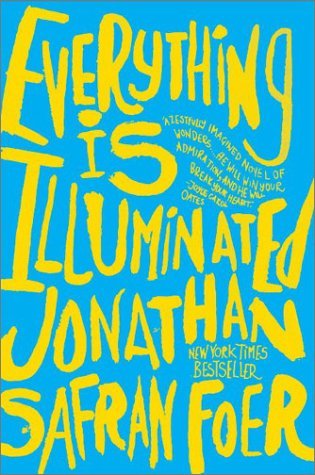
Book Review: "Everything is Illuminated" by Jonathan Safran Foer


Jonathan Safran Foer, 24 years old at the time of publication, has claimed his stake for literary greatness with his first novel Everything is Illuminated.

Illuminated is a different kind of novel. The ingenuity of Safran Foer’s wordplay and the structure of the story is the main attraction of the book.

The novel disguises itself as a story about the quixotic journey of a young man, who shares a name with the author, in search of a woman who allegedly saved his grandfather from the Nazis. Accompanied by Alex Perchov, a Ukrainian native, Alex’s “blind” grandfather, and their “seeing-eye bitch,” Sammy Davis, Jr. Jr. the characters explore themes such as love, history, memory, narrative, and death.

As their journey progresses, so does the development of its characters. The novel starts off with Alex giving a narration about himself, which gives way to his quirkiness, such as his ownership of a thesaurus but no dictionary.

“My legal name is Alexander Perchov. But all of my many friends dub me Alex, because that is a more flaccid-to-utter version of my legal name. Mother dubs me Alexi-stop-spleeningme!,

because I am always spleening her. If you want to know why I am always spleening her, it is because I am always elsewhere with friends, and disseminating so much currency, and performing so many things that can spleen a mother.”

Safran Foer’s play with Alex’s broken English gets to be obnoxious as you finish the chapter. But you can’t help but wonder how Safran Foer came up with this linguistic ingenuity. With every turn of the page, Alex’s English becomes less inhibited and gains dignity.

The novel contains two stories, both elaborately intertwined. Alex retells the story of his and Foer’s journey to Trachimbrod, a fictional Ukrainian shtetl (town). While in between chapters, excerpts of Jonathan’s novel-in-progress recount the history of Trachimbrod from its birth in 1791 to its death in the 1940s. These chapters are filled with famous monuments and excerpts from books written by inhabitants of Trachimbrod from its time to certify the existence of the shtetl.

The novel was adapted into a film starring Elijah Wood in 2005; however, it does not do justice to the book. The film presents itself in a manner lost in translation. The alterations of the plots change the meaning of the book altogether, abandoning most of the major themes.

With the wittiness of its verbal exchange and the humorous antics, Illuminated seems like a big joke. However, “everything is illuminated” by the time you reach the last word.